How Workplace Managers Outside Your Sector Handle Hybrid Space: Office vs. Campus vs. Hub
On the same Tuesday morning, three managers open three dashboards. A corporate facilities lead in a downtown office tower watches a floor that the booking sy…
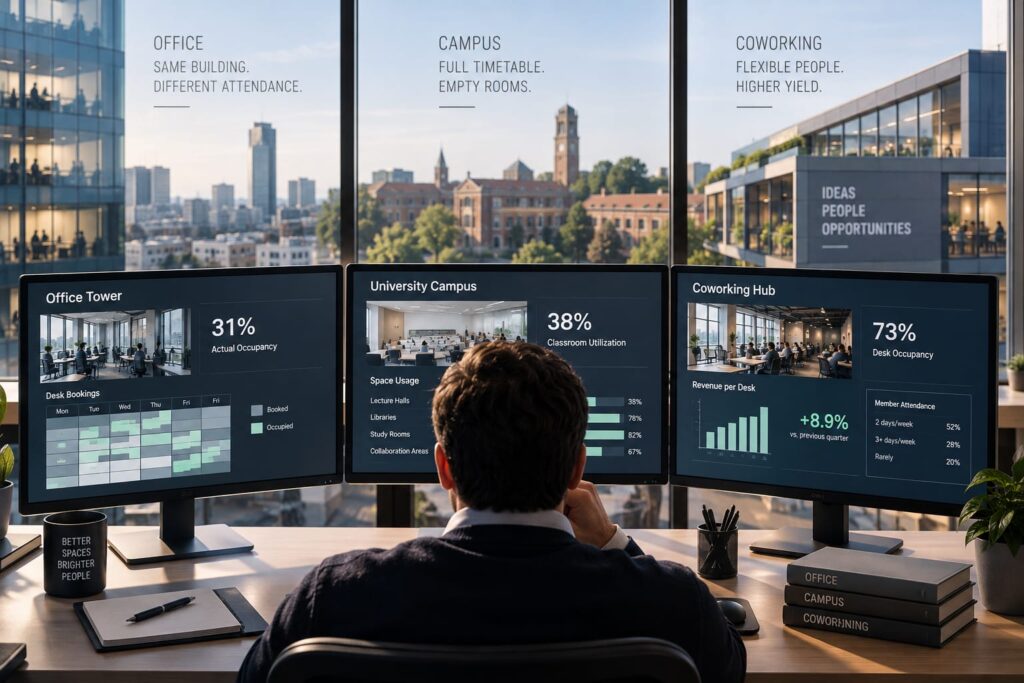
On the same Tuesday morning, three managers open three dashboards. A corporate facilities lead in a downtown office tower watches a floor that the booking system says is full and the badge readers say is barely a third occupied. A campus space planner two miles away looks at a timetable that has every lecture hall assigned for the semester, while the library two buildings over has a waitlist for study rooms. A coworking hub operator across town isn’t looking at an occupancy percentage at all — she’s watching yield per desk, because half her members show up twice a week and the other half never show up at all, and her business model depends on selling the same desk to more than one of them. Three people, the same underlying fact — nobody’s presence is predictable anymore — and three almost unrecognizable ways of managing it.
The office: chasing the gap between the calendar and the badge
Corporate real estate has settled on a single obsession: the distance between what the booking system says and what the sensors say. CBRE’s Global Workplace and Occupancy Insights research puts average office utilization across the Americas at just 31 percent, even as calendars show rooms and desks reserved well above that. The professional response to this gap has become the discipline itself — tracking “ghost bookings,” rebuilding KPIs around cost per occupied seat rather than cost per leased seat, and treating budget pressure as the forcing function: JLL research finds 84 percent of corporate real estate and facilities leaders now naming budget constraints and rising costs as their top concern, which means every square meter has to be defended with attendance data, not assumption. The office manager’s entire hybrid strategy, in other words, is built around closing a measurement gap between intention and behavior.
The campus: rigid scheduling, informal overflow
Universities start from the opposite structural position — and land on a strikingly similar problem from the other direction. Campus space is governed by timetables, not personal booking apps: classrooms are formally assigned by semester, and utilization is supposed to be enforceable by policy. It isn’t working that way. JLL’s Occupancy Benchmarking Report found peak classroom utilization averaging just 38 percent, well under the widely used 68 percent benchmark, with most classrooms scheduled far below the recommended 32 hours per week that planning firms treat as efficient use. The twist is where the missing demand actually goes: as hybrid and asynchronous learning pulls students out of scheduled lectures, libraries, informal study lounges, and collaboration areas fill up instead — the same inversion corporate offices are seeing with enclosed focus rooms absorbing overflow from failed open-plan seating, just relocated to a different building type. Campus planners describe discovering, once they finally run a proper space utilization study, that a campus which looks fully built out on paper is in practice significantly overbuilt in exactly the spaces the timetable insists are essential.
The hub: managing yield, not occupancy
Coworking operators never had the luxury of ignoring this problem, because their revenue depends on getting it right in real time. Rather than an occupancy percentage, the sector’s benchmark metric is RevPOD — revenue per available desk — precisely because a hub that is 100 percent booked at a discounted rate can be a worse business than one running lower occupancy at full price. OfficeRnD’s FlexIndex for the fourth quarter of 2025, covering more than 3,500 locations, put global desk occupancy at 73 percent and revenue occupancy at 74.49 percent, with price per hour of booking climbing 8.9 percent in a single quarter — evidence that operators are managing hybrid demand through pricing and inventory control, the way a hotel manages a variable booking calendar, rather than through fixed allocation. This model is no longer confined to coworking’s own four walls: roughly a quarter of large corporations have adopted “hub and spoke” strategies, distributing flexible nodes near where people actually live instead of concentrating everyone in one headquarters, and JLL projects that by 2030, 30 percent of all office space will be consumed flexibly rather than leased outright. The coworking hub isn’t a side category anymore — its operating logic is migrating into corporate real estate itself.
What each sector is missing from the others
Laid side by side, the three approaches look less like separate disciplines and more like three incomplete answers to one question. The office sector has the sensor infrastructure and the real-time occupancy data that campuses are only beginning to install, but it still thinks in fixed leases rather than the yield logic that lets coworking operators treat empty desks as a pricing problem instead of a sunk cost. Campuses have decades of experience running centrally enforced scheduling systems that most corporate FM teams would consider unthinkably rigid, yet apply that rigor to classrooms while leaving the informal spaces absorbing the real demand almost entirely unmanaged. Coworking hubs have built the most sophisticated real-time demand-pricing models of the three, but operate at a fraction of the physical scale of a corporate portfolio or a university campus, meaning their tools are proven at a scale most FM teams haven’t yet had to apply them at.
None of these sectors is failing to see the problem. They’re each measuring only the slice of it their existing tools were built to catch — which is exactly why the fastest-moving teams in every one of them have started reading each other’s benchmarks instead of just their own.
SOURCES
CBRE Global Workplace and Occupancy Insights Report; JLL Occupancy Benchmarking Report 2024; JLL corporate real estate and flexible workspace research; RDG space utilization studies on campus right-sizing; OfficeRnD FlexIndex, Q4 2025.
Workplace Insider workplaceinsider.eu