No Ferrari Budget Needed: 5 Factory Space Upgrades Within Reach of Every SME
Cases like BMW Leipzig or Ferrari Maranello show what happens when a company invests tens of millions of euros in its production space. But research on ergon…
Cases like BMW Leipzig or Ferrari Maranello show what happens when a company invests tens of millions of euros in its production space. But research on ergonomics, lighting, and work organization points to something more useful for most Italian businesses: many of the most substantial benefits — in terms of productivity, safety, and worker retention — come from interventions that cost little and can be carried out even in a small production facility. Here are five concrete improvements, backed by data that demonstrate their effectiveness.
1. Improve Lighting (Even Without Rewiring the Whole Plant)
The intervention
Make the best use of natural light already available — clearing windows and skylights that are often blocked by shelving or storage — and, where needed to supplement it, replace the oldest light fixtures with LED solutions in the most critical work areas, without necessarily redoing the entire lighting system all at once.
Why it works
According to a report from the International Labour Organization (ILO), improved lighting in some factories produced a 10% increase in productivity and a 30% reduction in errors. A scientific study conducted at an electronic components factory in the Netherlands also measured that moving from 800 to 1,200 lux at the workbench increased production speed by 2.9% in summer and 3.1% in winter.
The benefit
Fewer assembly errors, less waste, less visual fatigue — with an investment that, starting with the areas with the worst lighting, can be spread out over time and often pays for itself quickly through energy savings from the LEDs alone.
2. Reorganize Spaces with the 5S Method
The intervention
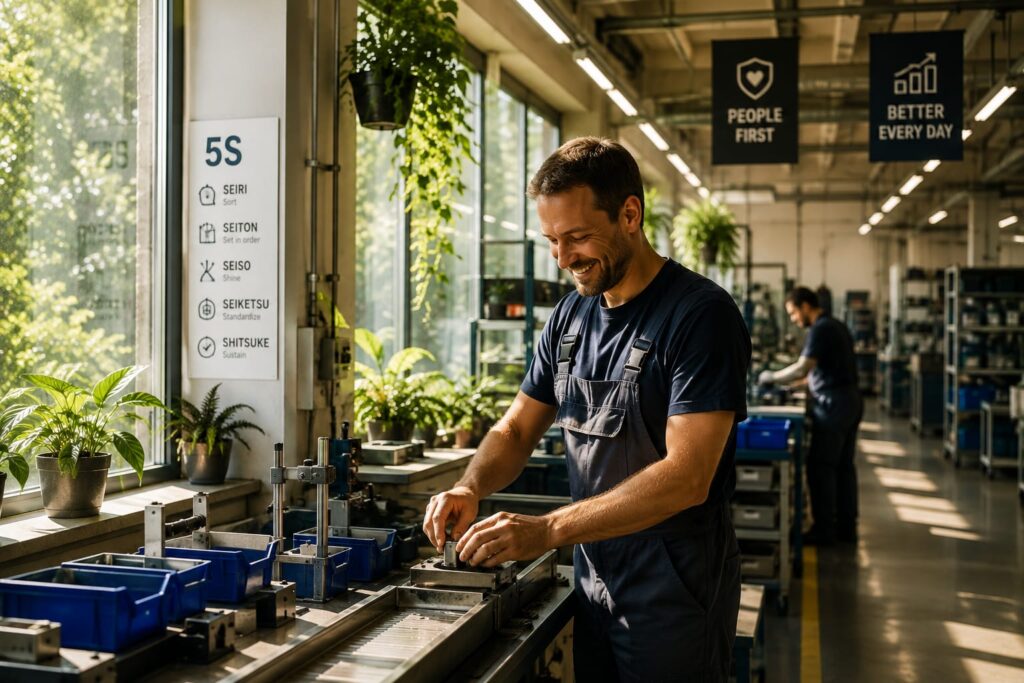
Apply the 5S method (sort, set in order, shine, standardize, sustain) to a single line or a pilot department: eliminate what isn’t needed, assign a fixed, visible place to tools and materials, and mark walkways and storage zones on the floor. It doesn’t require expensive consultants: public guidelines exist, and the method is designed to be applied by the workers themselves with minimal training.
Why it works
Several academic studies on small and medium-sized manufacturing firms document concrete results after introducing 5S: research on a small-scale manufacturing company recorded a substantial increase in operational efficiency, while other case studies in the automotive sector and other small production facilities report a significant reduction in time spent searching for tools and materials, along with improved workplace safety.
The benefit
Less downtime, lower risk of accidents linked to disorder, and — an effect often underestimated — a tangible improvement in worker morale, who perceive the environment as more cared for and professional.
3. Targeted Ergonomic Interventions, Not a Full Redesign
The intervention
There’s no need to redesign the entire production line: targeted interventions on individual high-risk workstations are enough — a pallet lifter where weights are repeatedly lifted, a height-adjustable workbench, a more ergonomic grip tool for a repetitive operation — identified by observing where the minor complaints reported by workers cluster.
Why it works
A documented case at a die-casting plant in Ohio saw, after introducing pallet lifters and other targeted measures, workplace injury insurance costs drop by 93%, absenteeism fall by 67%, and productivity increase by 54%. In another case, an ergonomics training program at a manufacturing plant led, over a ten-year period, to an 83% reduction in back injuries and a 32% reduction in related healthcare costs. A review of 250 case studies conducted by the Washington State Department of Labor and Industries confirms that the financial return on this type of intervention is almost always positive, even when the initial investment is minimal.
The benefit
A direct reduction in insurance costs and days lost to injury, plus a productivity increase that often pays back the initial investment in a short time.
4. Take Care of Break Spaces, Not Just the Production Line
The intervention
Invest in locker rooms, break areas, and restrooms that are clean, functional, and not neglected — even at a modest cost compared with renovating the production line. This includes small measures such as comfortable seating, a heated or air-conditioned break area, and quality water and beverage dispensers.
Why it works
An industry survey of manufacturing workers conducted in early 2026 found that 37% of those who left their most recent job did so because of a company culture perceived as poor, not because of pay, and the same data indicate that the quality of locker rooms, break areas, and restrooms weighs concretely on a worker’s decision to stay or leave, because it communicates respect for the people who use them every day.
The benefit
A direct effect on retention, which for an SME often carries an economic value higher than the cost of the intervention itself, given how expensive it is to replace an experienced worker in an already strained manufacturing labor market.
5. Introduce Natural Elements into Work Environments The intervention
Add plants, visible green elements at workstations, or simply open up a view onto an outdoor green area where possible — a low-cost intervention compared with building an actual natural area like Toyota’s at Burnaston, but based on the same principle.
Why it works
Research conducted on 100 workers, both blue-collar and white-collar, at a winemaking company in the Mediterranean area found a direct and significant effect of perceived sunlight on job satisfaction, intention to leave the company, and overall employee wellbeing; the mere sight of natural elements — trees, plants, vegetation — softened the negative impact of work stress on the intention to resign, even in the absence of other structural interventions.
The benefit
A measurable improvement in perceived wellbeing and a lower propensity to leave the company, achieved with an investment in the range of hundreds, not thousands, of euros.
The Common Thread
None of these five interventions requires the budget of a car manufacturer. What they require instead is a willingness to treat production space as a management lever on par with the production plan or the personnel budget — starting where the return is most immediate: a pilot department, a line with more injuries than others, locker rooms nobody has renovated in years. The data show that, even at small scale, the financial return on these interventions is almost always greater than their cost.
Main Sources
International Labour Organization (ILO), Occupational Safety and Health (OSH) Brief on workplace lighting. Scientific study on the effect of lighting on productivity at an electronic components factory (Netherlands), published in a peer-reviewed journal.
Case studies on 5S method implementation in small and medium-sized manufacturing companies (ScienceDirect, ResearchGate).
Case studies on low-cost ergonomic interventions (Dorn Companies; Washington State Department of Labor and Industries).
Manufacturing industry survey, Job Seeker Survey Q1 2026. Study of 100 workers at a Mediterranean winemaking company on the effect of sunlight and natural elements on workplace wellbeing.