McDonald’s and space as strategy: how a kitchen sketched in chalk invented the modern fast-food business
Before McDonald's scaled its menu, it scaled a workspace: a full-size chalk prototype that turned kitchen layout into a repeatable competitive advantage.
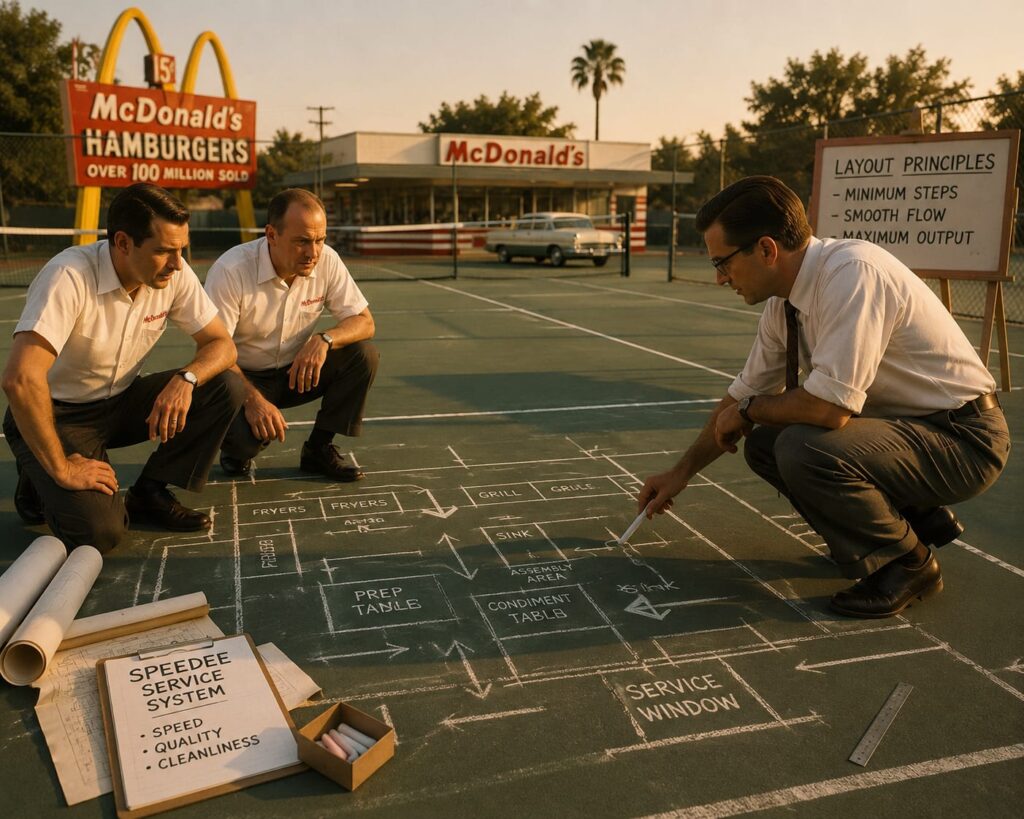
In 1948, in San Bernardino, California, Richard and Maurice McDonald made a decision no other restaurateur of the era had dared to make: they closed their successful drive-in for three months and redesigned it from scratch. They cut the menu down to nine items, switched to paper wrappers and plastic cups, and cut prices in half. But the real innovation wasn’t the menu. It was the physical space in which the food was prepared.
The problem: a layout built for service, not speed
Traditional drive-ins were organized around carhop service, with girls on roller skates delivering trays to cars, and kitchens designed for broad menus and long wait times. The McDonald brothers realized the real bottleneck wasn’t ingredients or staff, but the physical arrangement of workstations: how many steps a worker had to take between the grill, the condiment station, and the packaging area determined, more than any other variable, how many burgers could be served per hour.
The method: a tennis court as an ergonomics lab
To solve the problem, the brothers didn’t turn to outside consultants. They drew the exact measurements of every piece of kitchen equipment in chalk on a tennis court behind the McDonald house, assisted by local architect Charles Meston. The process, reconstructed by multiple historical sources and by Ray Kroc’s autobiography Grinding It Out, had employees stand on the chalked lines and physically walk through every motion of production, from the grill to packaging, while the brothers watched and adjusted the layout.
The sources agree on a telling detail about the method: the group stayed on the court for nearly eight hours, erasing and re-chalking the entire layout three times, refining every element until they had a genuinely functional sequence of movements. One night of rain wiped out the first finished drawing, forcing them to start over. Beyond its color, the anecdote shows just how iterative and experimental the process was, rather than the product of a single flash of insight.
The result was the "Speedee Service System": a kitchen where every station, from fryers and condiment dispensers to prep areas, was positioned to minimize staff movement, following a logic almost identical to industrial assembly lines and applied for the first time to mass food service. The new building, with its red-and-white tile surfaces, stainless steel, brightly colored sheet metal, and neon, also included two 25-foot yellow arches the brothers named the "Golden Arches" right at the design stage.
The experiment belongs to the same family of workplace decisions explored in the factory’s modern makeover: the physical environment is not scenery around the work. It is part of the operating model.
From prototype to system: standardization under Ray Kroc
An efficient restaurant, however groundbreaking, remains an isolated case until someone finds a way to reproduce it elsewhere without losing quality. That’s where Ray Kroc came in, a milkshake-mixer distributor struck by the brothers’ unusually large equipment orders. In 1954 Kroc became a franchise agent for the brothers, and in April 1955 he opened what would become the chain’s first restaurant east of the Mississippi, in Des Plaines, Illinois.
Growth was initially slow: by 1958 Kroc held exclusive franchise rights and owned 38 restaurants; the following year, 68 more opened. The real leap in scale came soon after: by the time Kroc bought out the McDonald brothers in 1961 for $2.7 million, he had already built a network of 228 restaurants generating $37 million in sales.
Kroc’s success wasn’t a new idea. It was the ability to turn the experimental layout from San Bernardino into a transferable protocol. Kroc chose to sell single-unit franchises rather than the broader territorial rights common in the industry at the time, in order to keep direct control over service uniformity. Every franchisee was bound to follow the same physical layout and procedures tested on that tennis court. To guarantee this consistency, in 1961 Kroc launched a training program that later became known as Hamburger University, teaching franchisees not just recipes, but the exact placement of every workstation.
The guiding principle, summed up in the acronym QSC, Quality, Service, Cleanliness, and later joined by Value, became the non-negotiable mantra on which Kroc built the entire empire, starting from that first franchise in Des Plaines in 1955.
The legacy: workspace design as a scalable competitive advantage
What makes the McDonald’s case relevant well beyond the restaurant industry is the underlying methodology: physically testing a work layout through full-scale simulation before building it, rather than relying on theoretical floor plans. This approach anticipates by decades what would later be formalized as time-and-motion studies applied to workspace design, and it echoes directly in the "form follows function" principles still used today in high-volume foodservice.
The lesson also explains why removing walls without designing for the work itself so often disappoints. A layout creates value when it is tested against real movements, handoffs, and constraints, not when it simply follows the dominant design fashion.
The combination of an optimized physical layout with an industrially scalable standardization system is what allowed McDonald’s to become, within a few decades, a global model. It was not a culinary invention, but an invention in spatial ergonomics, capable of turning a local advantage into a competitive edge that scaled worldwide. Each month, The Workplace Report examines the same relationship between physical space and performance across offices, factories, warehouses, and worksites.
Sources
- History of McDonald’s, Wikipedia.
- The Real McDonald’s: The San Bernardino Origins of a Fast Food Empire, PBS SoCal.
- Refining the Plan: Hamburgers on the Tennis Court?, Rapid Start Leadership.
- The Founder: How a Tennis Court Revolutionized Foodservice Design, Quel’s Corner.
- Ray Kroc, Britannica Money.
- Raymond "Ray" Kroc, Rosenberg International Franchise Center, University of New Hampshire.
- Ray Kroc: The Tireless Salesman Who Built the McDonald’s Empire, Zentara.
- How McDonald’s Built its Burger Empire, The Motley Fool / AOL.
- Ray Kroc, Grinding It Out: The Making of McDonald’s.