The Factory Gets a Makeover: How Industrial Space Is Changing to Win Over Gen Z
Manufacturing needs 3.8 million new workers and risks leaving half those jobs empty. The companies winning the talent battle are rebuilding the factory itself, not the recruiting pitch.
For decades, the collective image of the factory has stayed frozen in a black-and-white snapshot: dark sheds, noise, grease-stained overalls, anonymous assembly lines. It’s an image that still circulates in school textbooks and in the perception of anyone who has never actually seen the inside of one, and it is now becoming a concrete economic problem, not just an aesthetic one.
A reputation problem that costs jobs
According to Deloitte and The Manufacturing Institute’s 2024 study, the U.S. manufacturing industry will need roughly 3.8 million new workers between 2024 and 2033, but if the skills and applications gap isn’t closed, as many as 1.9 million of those jobs, more than half, risk staying vacant. It’s no surprise that 65% of manufacturers surveyed in the National Association of Manufacturers’ quarterly outlook cite attracting and retaining talent as their top challenge. Figures like these, one spread per work environment, are what we collect each month in The Workplace Report.
According to industry recruiters, the problem starts well before the job interview: many students choose a career path still picturing dark, dirty factories, an image far removed from what a modern production floor actually looks like today. It’s a paradox, because in terms of skills, Gen Z, raised on smartphones and constant access to data, is considered by the World Economic Forum to be particularly well suited to smart manufacturing environments, where digital fluency and the ability to work alongside artificial intelligence are now in demand just as much as manual skill.
Tearing down the walls, literally: the BMW Leipzig case
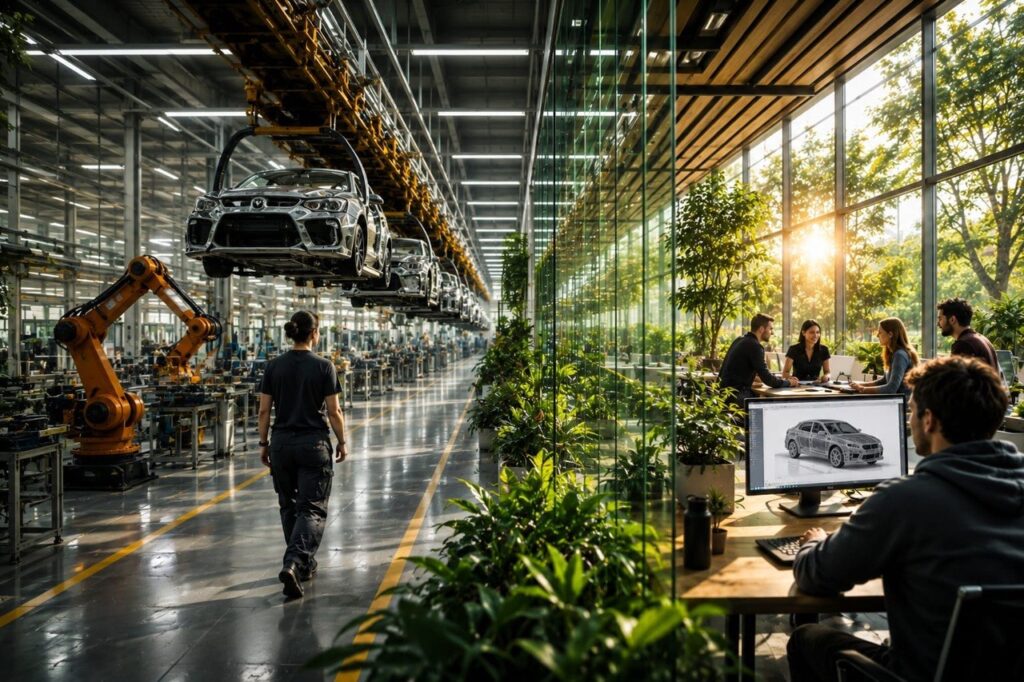
The most internationally cited case of architectural transformation in a production facility is the central building of BMW’s plant in Leipzig, Germany, designed by architect Zaha Hadid and opened in 2005. The idea behind the project was as simple as it was radical: route the production line, with cars still being assembled suspended on a conveyor, directly above the design and administrative office desks, in a single space shared by roughly 750 people, both factory workers and office staff.
BMW’s stated goal was to overcome the traditional physical and social separation between production workers and office staff: at the Leipzig plant, workers’ locker rooms and social spaces are also located on the first floor, mixed in with administrative areas, and informal communication spaces were designed specifically to bring the two groups of employees together without separate hierarchical paths. Twenty years after it was built, the building is still cited as a textbook case of how industrial architecture can communicate, literally and visibly to every employee and visitor, that production and design are part of the same organization, without separate status. It is worth noting how different this is from the office world’s open-plan wave, where removing walls alone delivered far less than promised. Leipzig worked because the mixing was designed, not just permitted.
The science behind the glass walls
This isn’t just architectural symbolism: scientific literature confirms that a production floor’s environmental conditions have a measurable effect on the wellbeing of the people who work there. A study of 100 workers, both factory floor staff and office employees, at a winery in the Mediterranean region found a direct, significant effect of perceived sunlight exposure on job satisfaction, turnover intention, and overall employee wellbeing; the sight of natural elements such as trees, plants and vegetation also softened the negative impact of work-related stress on the intention to quit.
Some major industrial groups have translated these principles into concrete site decisions. Toyota, for instance, created a nature reserve within its Burnaston plant in the United Kingdom. The U.S. company Interface, a maker of office flooring, launched a pilot project called “Factory as a Forest,” designed to make the plant function according to the same principles as a high-performing natural ecosystem. These are choices that also respond to an explicit expectation among newer generations of workers, for whom environmental sustainability and the quality of physical space are now criteria for evaluating an employer, not mere extras.
What Gen Z actually wants (and what’s already working)
Satisfaction data among young people already working in the sector tells a more encouraging story than the stereotype suggests: in a UKG survey conducted in partnership with IndustryWeek, 92% of Gen Z workers already employed in manufacturing said they were satisfied with their careers. The problem, then, isn’t the reality of the job once you’re in. It’s convincing young people to cross that threshold in the first place, and then keeping them once hired.
On this front, the data points to specific priorities. According to Randstad’s 2025 Workmonitor survey, half of Gen Z workers consider a lack of training and growth opportunities a sufficient reason to leave a company, compared with a third of Baby Boomers. The same Deloitte and Manufacturing Institute study found that 47% of manufacturing workers cite schedule flexibility, meaning swappable shifts and split hours, as the most effective factor in their decision to stay with a company, and that workers who believe they can acquire the skills needed for their future are 2.7 times less likely to leave their company within the following twelve months.
Work tools themselves are also changing in response to these expectations: augmented reality, virtual reality headsets, and machine vision systems are increasingly used for on-the-job training, replacing traditional paper manuals with visual, immediate content, a language closer to a generation that has never known a world without smartphones.
The thread that connects all these changes
Whether it’s a building designed by a star architect, a nature reserve inside a production plant, or simply an augmented-reality headset replacing a technical manual, the common thread running through these changes is the same: making it visible, architecturally, environmentally and technologically, that working in a factory today is not what the textbooks describe. The companies winning this battle for talent aren’t just saying so in an advertising campaign; they’re proving it in the physical space where workers spend more time, every day, than they do at home. It is the same conclusion our look at hybrid work reaches from the opposite direction, where the more work dematerialises, the more the physical workplace matters.
Sources
- Deloitte and The Manufacturing Institute (2024). Taking Charge: Manufacturers Support Growth With Active Workforce Strategies.
- National Association of Manufacturers, Q1 2024 Outlook Survey.
- World Economic Forum (2025). “Why Gen Z Is the Perfect Fit for Smart Manufacturing.”
- Zaha Hadid Architects / Zaha Hadid Foundation. BMW Central Building, Leipzig (2005).
- Study of 100 workers at a Mediterranean winery on the effect of sunlight and natural elements on workplace wellbeing.
- Interface Inc., “Factory as a Forest” project (SAP case study, 2018).
- UKG and IndustryWeek, survey on Gen Z satisfaction in manufacturing.
- Randstad, Workmonitor 2025.