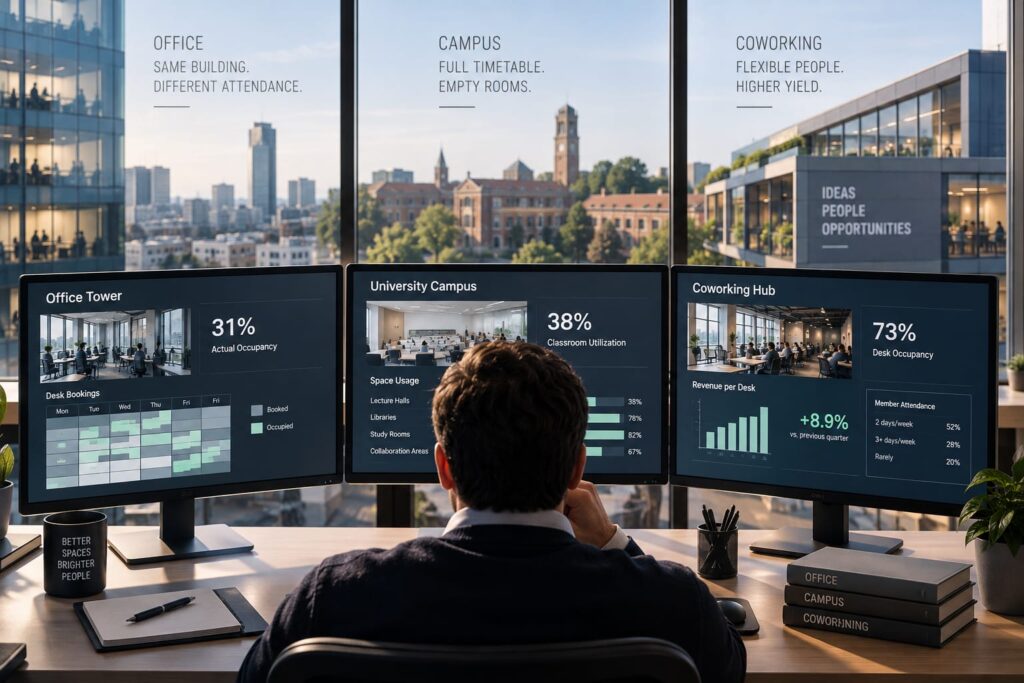
The space paradox: the more we work remotely, the more the physical workplace matters
As work dematerialises, the space that remains stops being a cost line and starts being the only place certain things can happen at all.

There is a paradox that companies are discovering the hard way, and the data backs it up. The more work dematerialises, through remote arrangements, distributed teams and meetings that happen on a screen, the more the physical space that remains becomes an asset to look after rather than a cost to squeeze. That is not nostalgia dressed up as strategy. It is what the recent research on culture, retention and belonging keeps finding.
The paradox, in numbers
The Gensler Research Institute surveyed more than 16,800 workers across 15 countries and 10 industries for its Global Workplace Survey 2025, and found something that should give pause to anyone who assumes the office question has been settled. On average, employees spend around 55% of their week in the office. Asked how much time they would need to be there to do their best work, they answer around 65%.
Read that gap again, because it runs against the usual story. People are not straining to be at home as much as humanly possible. They are asking for an office that justifies the journey.
The same research shows something structural underneath it. Since the survey began in 2008, the share of office time spent on individual work has fallen steadily, while time spent learning and socialising has doubled compared to before the pandemic. People increasingly do not come in to work alone in silence, which they can do perfectly well elsewhere. They come in for the things a shared building offers and a kitchen table does not. Whether the building actually delivers those things is a design question in its own right, and the open-plan research shows how easy it is to get wrong.
From the other direction, Gallup has been tracking global engagement for years, and the recent picture is consistent with all of this. Workers under 35 and those who are fully remote are the groups hardest hit by falling engagement, with a parallel rise in reported loneliness, particularly among remote workers in North America. Dematerialised work, left without a counterweight, seems to cost exactly what holds people in a company: the sense of belonging somewhere.
Culture is built in the building
If individual work can happen anywhere, what stays stubbornly tied to shared physical space is everything that comes out of the unplanned encounter. The remark exchanged in a corridor. The question you put to a more experienced colleague without having to book a call to ask it. Watching how someone good at the job actually does it.
That is the same mechanism that sits underneath mentoring. Gallup’s data shows employees who have a mentor are roughly twice as likely to be fully engaged in their work as those who do not, and those relationships overwhelmingly begin and deepen through informal moments of proximity rather than a structured calendar invite.
Gensler has measured how much the quality of shared space matters, not just its quantity. Employees who feel they have real choice over where and how they work are 2.5 times more likely to say their environment supports both individual and team productivity, and almost three times more likely to describe their office as a great place to work.
The starkest figure is about pride. Among employees who like their workspace, 90% say they are proud to work for their company. Among those who feel disconnected from their environment, that falls to 47%. A gap of more than 40 percentage points, produced by the quality of a physical space.
Culture moved onto the balance sheet
One 2025 data point shows how far this has climbed the executive agenda: 92% of surveyed executives now consider a strong company culture decisive for business success. Not a value printed on a poster in reception, but a lever with money attached.
That also explains why mandating a return without investing in the place people are returning to keeps failing. Companies that impose full-time attendance without offering an environment that earns the commute find it progressively harder to attract and keep people. The mirror image is more interesting. According to an analysis combining McKinsey, Stanford and Gallup data, the share of workers primarily on site doubled between 2023 and 2025, and not because of mandates. It happened where companies gave people real reasons to come in, through renovated space and collaboration worth showing up for.
The same rule on the factory floor
None of this is only about desk work. In production environments, where remote work was never an option, looking after the physical space turns out to be just as direct a retention factor.
A survey of manufacturing workers conducted in early 2026 found that 37% of those who left their most recent job did so because of a company culture they experienced as poor. Not pay. The same data shows that well-maintained changing rooms, break areas and washrooms weigh materially in the decision to stay or go, because they signal whether the people using them are respected.
Industrial case studies point the same way, and the interventions are unglamorous. A monthly recognition programme for shop-floor workers. Renovating break areas shared between warehouse and office so the two worlds stop feeling like separate castes. Better safety equipment. One steel producer introduced an AI-based safety monitoring system and cut workplace injuries by 40%, with a measurable knock-on effect on satisfaction and turnover. The most ambitious manufacturers are going further still, redesigning the factory itself to win over a new generation of workers.
What to take from this
The thread connecting the office, the plant and the warehouse is the same one. In an era where technology makes it ever easier to work without sharing a space, that space, where it still exists, stops being a container and becomes the place where shared culture, belonging and the informal handover of expertise between generations either get built or quietly erode.
For anyone deciding policy and layout, that comes down to three things.
First, treat physical space as strategic infrastructure rather than a cost line to compress. The perceived quality of the environment moves pride, engagement and retention in ways you can measure, and if you want the benchmark numbers to start from, The Workplace Report collects them in one monthly PDF.
Second, the value of the office has shifted from individual work to relationships. If people can work alone anywhere, the only honest reason to gather them somewhere is what that place lets them do together.
Third, the principle does not stop at the office door. In production environments, where remote work does not exist, the state of the shared spaces, the changing rooms, the break areas, the safety equipment, is as concrete a retention factor as the salary.
The question worth asking is no longer how much space we need. It is this: what happens in our spaces that could not happen anywhere else, and are we investing as though we believe it?
Sources
- Gensler Research Institute, Global Workplace Survey 2025. Over 16,800 workers, 15 countries, 10 industries.
- Gallup, State of the Global Workplace, and engagement data 2024 to 2026.
- Gallup, research on mentoring and employee engagement.
- Manufacturing sector Job Seeker Survey, Q1 2026.
- Comparative analysis of McKinsey, Stanford and Gallup data on hybrid work, 2023 to 2025.