The Workplace Manager in Five Years: From Square Footage to Behavioral Data
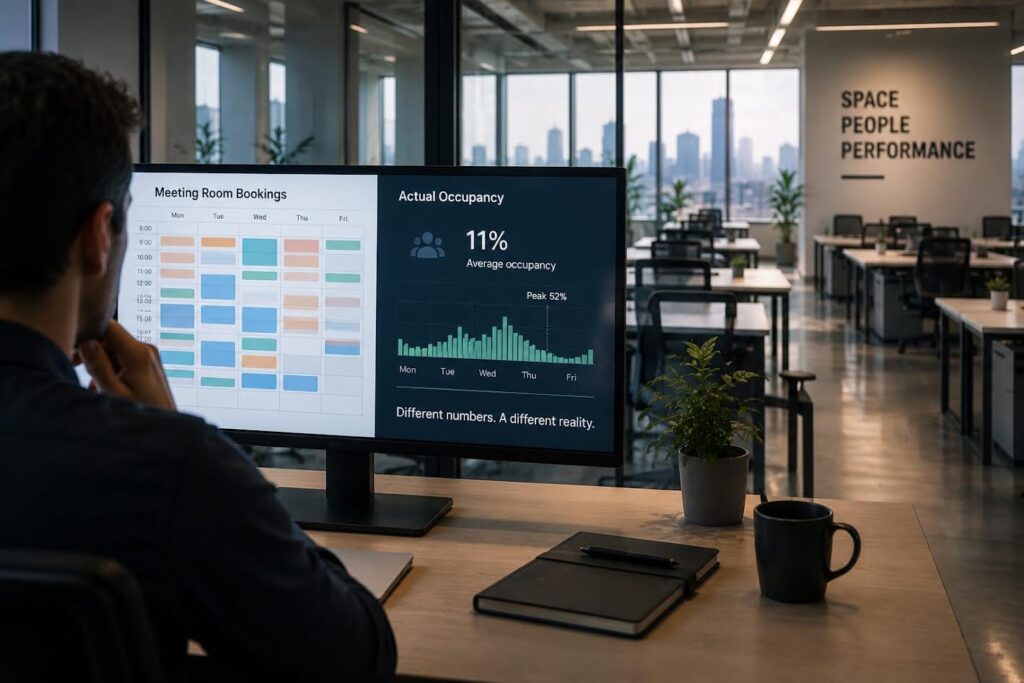
A facilities team pulls up its booking system on a Tuesday afternoon and sees what looks like a healthy office: meeting rooms reserved back to back, desks marked as taken, a calendar that suggests the floor is working exactly as designed. Then the sensor data comes in. Average occupied capacity across the portfolio sits between 9 and 11 percent. Peak capacity, concentrated into a narrow midweek window, reaches 52 to 60 percent. The booking system and the building are describing two different places. This is not a hypothetical - it is the pattern the ninth edition of the Occupancy Intelligence Index has now recorded consistently across a full year of measurement, and it is the moment a growing number of facility managers are confronting for the first time: the numbers they have always trusted were never measuring what they thought.
The metric that quietly stopped working
For decades, the facility manager’s core unit of account was square meters – how much space the organization leased, how it was allocated, what it cost per desk. That unit made sense when presence was assumed. It stops making sense the moment presence becomes variable, and the data now shows just how variable it is. CBRE’s Global Workplace and Occupancy Insights research found office utilization in the Americas averaging only 31 percent, with assigned private offices sitting empty roughly 77 percent of the working day. The Occupancy Intelligence Index adds a layer facility managers cannot see from badge counts or booking logs alone: a structural mismatch in space type, not just space volume. Enclosed focus rooms make up only 8 percent of measured footprint but run at 77 percent occupied capacity, while open focus areas absorb the overflow at 85 percent – office layouts are pushing concentration work into space that was never designed to hold it. Meanwhile enclosed collaboration space runs an 18 percent shortage at 2 p.m. across the same portfolios. A square-footage report tells a facility manager the building isn’t full. A behavioral dataset tells them which four percent of it is failing, and when.
This is why booking-to-attendance ratios have become a working KPI in their own right: when reservations run consistently above actual occupancy, teams are managing “ghost bookings” – a distortion that inflates apparent demand and, left unaddressed, leads directly to over-provisioning space the organization doesn’t need to lease in the first place.
A new professional tier is already being hired for
The industry has a name for where this is heading. IFMA and multiple facilities-technology research groups now describe the emergence of the FM Data Analyst as a distinct professional tier, sitting alongside – not replacing – the operational facility manager. Dr. Matt Tucker, IFMA’s Director of Knowledge & Insights, has pointed to the core problem driving this: most facilities professionals are learning to interpret data on the job, without any formal training pipeline built for it. That gap is exactly what is now being closed through hiring rather than curriculum. Organizations are recruiting for roles that combine traditional facilities knowledge with the ability to read sensor dashboards, build KPI structures, and communicate findings in terms a CFO will act on.
The financial pressure behind this shift is documented, not speculative. JLL research cited by facilities analysts found 84 percent of corporate real estate and FM leaders now list budget constraints and rising operating costs as their top concern – which means every square meter under management has to be justified with a number, not a description. That single pressure is what turns “manager of space” into “manager of the evidence for space decisions.”
The tools are already shifting the job description
Adoption data confirms this isn’t a five-year forecast so much as a trend already mid-flight. Johnson Controls’ 2026 workplace AI survey found 65 percent of business leaders now using AI to improve workplace operations, and – more tellingly for facility teams specifically – 45 percent of leaders implementing a workplace management solution are deploying environmental and occupancy sensors, up from just 30 percent in 2024. That is a 15-point jump in two years, concentrated in exactly the sensor categories – motion, thermal, computer vision – that produce the behavioral datasets facility managers will be expected to own, clean, and interpret.
IFMA’s own skills guidance for the profession now lists data literacy with CMMS and IWMS dashboards alongside the traditional MEP knowledge, budget negotiation, and emergency decision-making that have always defined the role. The job has not been replaced. It has been layered: the same person who once walked the floor checking HVAC output is now expected to explain, with a chart, why enclosed collaboration space needs to double while open-plan desking can shrink.
What five years actually changes
The facility manager of 2031 will not have stopped managing physical space – buildings, leases, and maintenance schedules don’t disappear. What changes is the currency they manage it in. Cost per occupied seat replaces cost per leased seat as the metric finance responds to. Co-attendance rate – the share of a team actually in the building on the same day – becomes a planning input for collaboration space, not an afterthought. Portfolio decisions on renewal, consolidation, or footprint reduction increasingly run on six to twelve months of validated occupancy data rather than anecdote and walkthroughs.
The organizations moving fastest are not the ones buying the most sensors. They are the ones that have already started training the people who read them – because the data existed for years before anyone in the building was equipped to argue with a lease renewal using it.
Sources
Occupancy Intelligence Index (9th edition, VergeSense); CBRE Global Workplace and Occupancy Insights Report; IFMA (Dr. Matt Tucker, Director of Knowledge & Insights; IFMA Core Competencies and skills guidance); Johnson Controls 2026 Workplace AI Survey; JLL corporate real estate and facilities management research.