5 Common Problems for Event and Conference Room Managers (and How to Solve Them)
Budget overruns, dead Wi-Fi, and guests hunting for an outlet aren't bad luck. They're the same five failure points showing up on every event, and each one has a known, sizeable fix.
Ask any event or conference room manager what keeps them up the week before a summit, and the list is almost always the same five items, in almost the same order. That repetition is the tell. These aren’t one-off disasters caused by bad luck or an unlucky vendor. They are structural failure points that show up on nearly every event of a certain size, and every one of them has a technical fix that has already been worked out by people who run these rooms for a living.
1. Budget and AV/venue cost overruns
The problem is rarely the budget itself. It’s the shape of it. Most event quotes bundle heterogeneous line items, technology, staffing, setup, into indistinct blocks, which makes it close to impossible to know where to cut when costs start climbing. The fix is to break the budget into separate, comparable cost centers, AV rental, technical staff, catering, setup, and contingency, with an explicit contingency margin of 10 to 15 percent of the total reserved exclusively for vendor-driven extras such as streaming surcharges or last-minute bandwidth upgrades.
Each line item should be quoted separately by vendors rather than bundled, so cuts can be made selectively without touching the items that actually affect perceived quality, acoustics, speakers, the key catering moments. And the review shouldn’t happen once, at the start of planning. It should sit on a fixed schedule, for instance at 90, 45, and 15 days out, so a cost creeping upward gets caught while there’s still room to act on it.
2. Undersized bandwidth and access point density
Network capacity should be sized on peak simultaneous load, not on the daily average or the registered attendee count, which is the single most common sizing mistake. A more reliable baseline: 1.5 to 2 connected devices per attendee, access points calibrated to no more than 30 to 50 concurrent users per radio in high-density areas (square footage alone is a still-common but insufficient criterion), and bandwidth estimates that differ sharply by event type, from 1 to 5 Mbps per person for a standard business event to well over 50 Mbps per person for a hackathon or a multi-camera live stream.
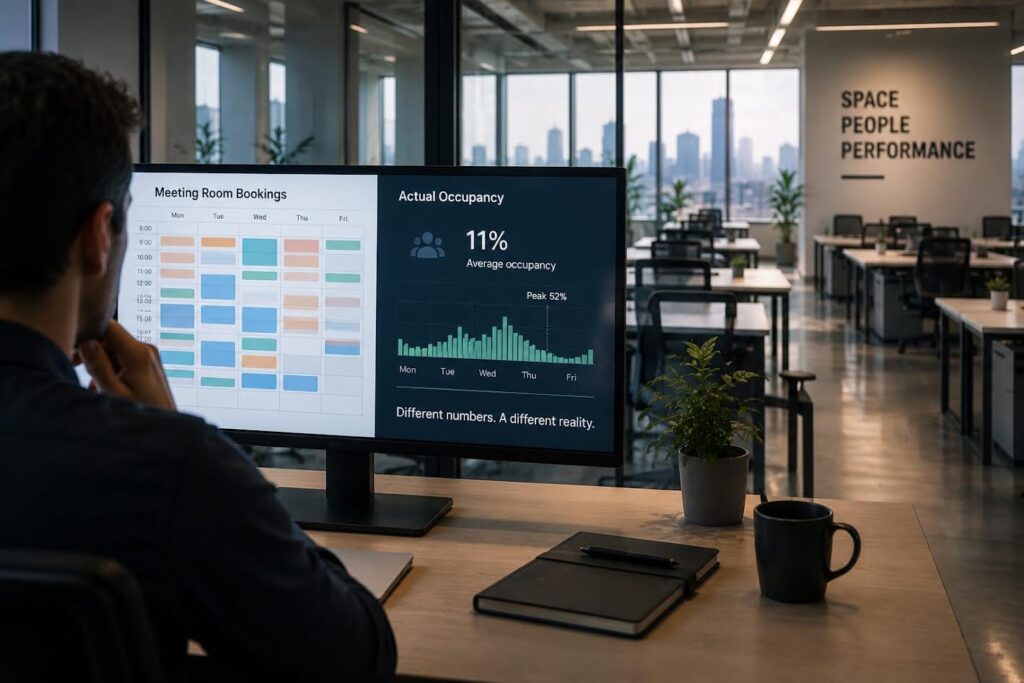
It also matters to request a dedicated connection from the venue rather than one shared with the rest of the building, and to ask for a post-event Wi-Fi usage report as a benchmark for the next one. That single habit replaces guesswork with actual historical data, the same shift that changes how any physical space gets planned once real usage data exists rather than assumed at the drawing-board stage.
3. Insufficient power points for guests
Power demand scales with event duration far more than with attendee count, and that’s the sizing error that trips up even experienced planners: a two-hour indoor event and a twelve-hour one with the identical audience have wildly different charging demand. The first step is simply auditing the venue’s fixed outlets and supplementing with power strips along working tables and networking areas, sized for a realistic simultaneous load so no single circuit gets overloaded.
For high-volume or extended events, the structural answer is a high-capacity power bank dispenser, a self-service kiosk that hands out portable batteries and lets guests return them at any charging point on the network, not necessarily the one they picked up from. Unlike locker-based stations, a dispenser scales with simultaneous users because each unit serves one guest at a time independently, with no staff needed to supervise individual lockers. The rule of thumb is one station per 500 to 1,000 expected concurrent users, with extra density in food and beverage and networking areas where dwell time runs longer. Industry data points to attendee satisfaction rising over 12% at venues with structured charging, and time spent on-site climbing close to 20% at multi-hour festivals and trade fairs, a pattern that echoes what happens when any workplace removes a low-grade daily friction that people had simply learned to tolerate. Worth asking any hardware vendor up front: rated capacity and delivered capacity aren’t the same number. Real output, once conversion losses and thermal throttling under sustained use are accounted for, typically lands at 60 to 80% of what’s on the label.
4. A fragile supply chain with no redundancy
Vendor risk needs contractual tools, not informal tolerance margins. That means a RACI matrix for every critical vendor, spelling out who decides, who executes, who’s informed, and by when; explicit SLAs with penalties for delay or non-delivery, weighted by how severe the impact actually is (a missed setup slot is not the same failure as missed live audio); and a pre-contacted, pre-qualified backup for every single-point-of-failure role, catering, AV, security. It’s the N+1 principle borrowed straight from infrastructure engineering and applied to event logistics. Verification check-ins belong on a fixed cadence in the six to eight weeks before the event, not left to whichever vendor remembers to call.
5. Technical complexity and falling engagement in hybrid events
The tools have multiplied, multi-camera streaming, LED walls, recording kiosks, real-time polling, and with them the case for a dedicated AV production function separate from general event coordination, with one person, a technical director, holding single point of responsibility on-site. For hybrid events specifically, remote engagement runs nearly 30% below in-person participation, and that gap is an experience design problem more than an infrastructure one. The fix is a separate run-of-show for the remote audience, with its own structured interaction moments, moderated Q&A, synchronized polling, breakout rooms, timed independently from the in-room program instead of treating the stream as a passive recording of what’s happening on stage.
None of these five problems is exotic. They recur because event production keeps repeating the same underlying assumption, that a room’s needs can be estimated from its size and its guest count. Once you size for peak load, duration, and failure instead, the fixes stop being emergencies and start being line items you planned for. For teams sizing charging infrastructure specifically, the calculator walks through the concurrent-user math above for your own event footprint.
Sources
- Convene’s 31st Annual Meetings Market Survey, PCMA.
- SmartSource, “Event Wi-Fi Requirements: How to Calculate Bandwidth for Conferences.”
- Ticket Fairy, “Event Wi-Fi & Networking in 2026.”
- Juuce, “Phone Charging Stations for Events: Complete Guide.”
- Veloxity, “Rent Phone Charging Stations for Events.”
- JustAttend, “Mobile Power Bank Rental Kiosks For Events.”
- Power Bank Tests, “Power Bank Kiosk Business ROI” (effective delivered capacity data).
- VenueWise, “10 Key Challenges in Event Planning and How to Solve Them in 2024.”
- Associate Events, “The Biggest Pain Points in Event Planning, and How to Overcome Them.”
- PheedLoop, “10 Emerging Event Planning Challenges in 2026,” referencing the LinkedIn Workplace Learning Report 2024.