What a warehouse’s walking routes revealed about its workstations
A warehouse case study found 38 hours of non-value-added work a day. Its layout changes were one part of a broader program that improved picking and packing efficiency.
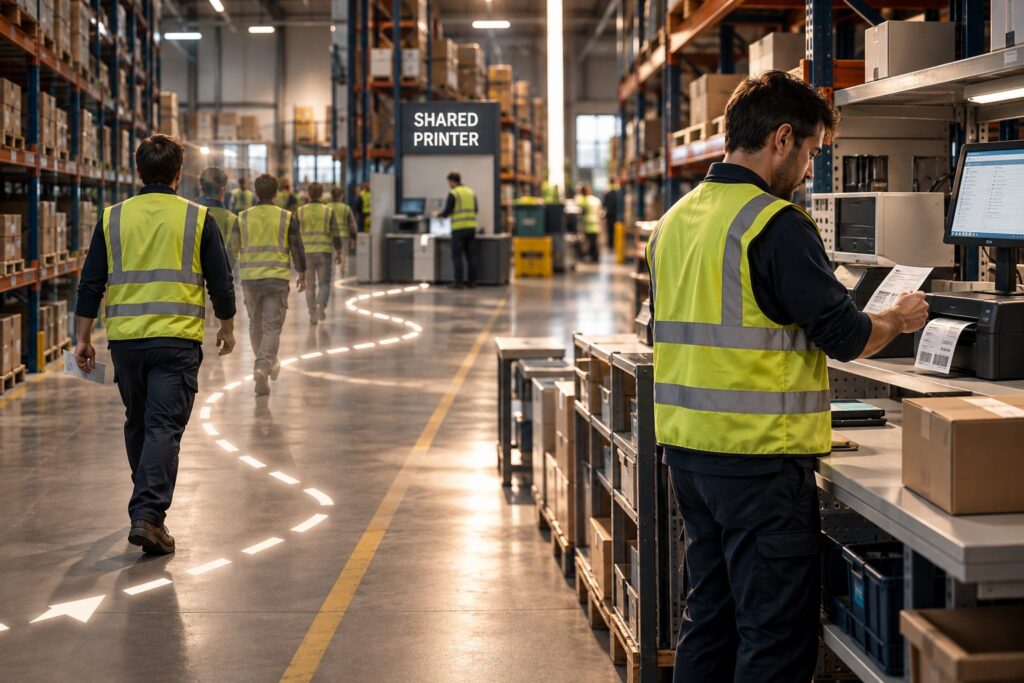
At an aeronautics manufacturer’s logistics warehouse, researchers counted 38 hours of non-value-added work per day across two shifts. Much of it involved movement: clerks crossed the order-preparation area to use equipment, handle packages and complete checks.
The team did not start by choosing new machinery. It watched the work. Over three days and two shifts, researchers made 85 observations of warehouse clerks, then mapped routes and measured the time spent on each operation. Their planned sample was 178 observations, so the findings should be read as a focused case study rather than a general benchmark.
A printer can shape the route of an order
The analysis traced repeated trips between clerks, computers, welders, printers and scales. A tool shared across stations can turn a short packing step into another walk. Those movements become easy to miss when each trip is considered separately.
The researchers proposed workstations with the materials needed to prepare an order in one place. They called the arrangement W2P: one workstation, one product and one person. They also proposed combining picks for several orders in the same storage zone, so a clerk would travel the route once instead of repeating it for each order.
Layout was one part of the improvement
The study examined more than equipment placement. It also looked at overlapping quality checks and the way picking trolleys were used. In the researchers’ breakdown of simulated time savings, layout changes accounted for 35%, controls for 44% and trolley changes for 21%.
The paper reports a 30% increase in picking and packing efficiency for the overall lean improvement program. That figure should not be attributed to moving printers alone. It is the result reported for a package of changes at one warehouse.
For an operator facing a similar problem, the useful first step is concrete: follow an order from pick to pack, record every trip to a printer, screen or scale, and count how often that trip repeats in a shift. The route may reveal a workstation problem before it reveals a case for automation.
Source: Naila Fares and colleagues, “Lean implementation case study for manual order picking and packing in warehousing operations”, International Journal of Lean Six Sigma (2025). The paper is a single-site case study; its results may not generalize to other warehouses.