Five Factories That Reinvented Production Space (and the Measured Benefits)
Five manufacturers show how workplace design can improve integration, wellbeing, sustainability and operational performance.
When people talk about innovation in manufacturing, the conversation almost always turns to robots, artificial intelligence, and automation. But some of the most effective transformations of the last twenty years have involved something simpler and often overlooked: the physical space where people work every day. Here are five real cases, with documented results, of companies that rethought the production environment, not just the process.
1. BMW, Leipzig (Germany): Breaking Down the Separation Between Production and Office
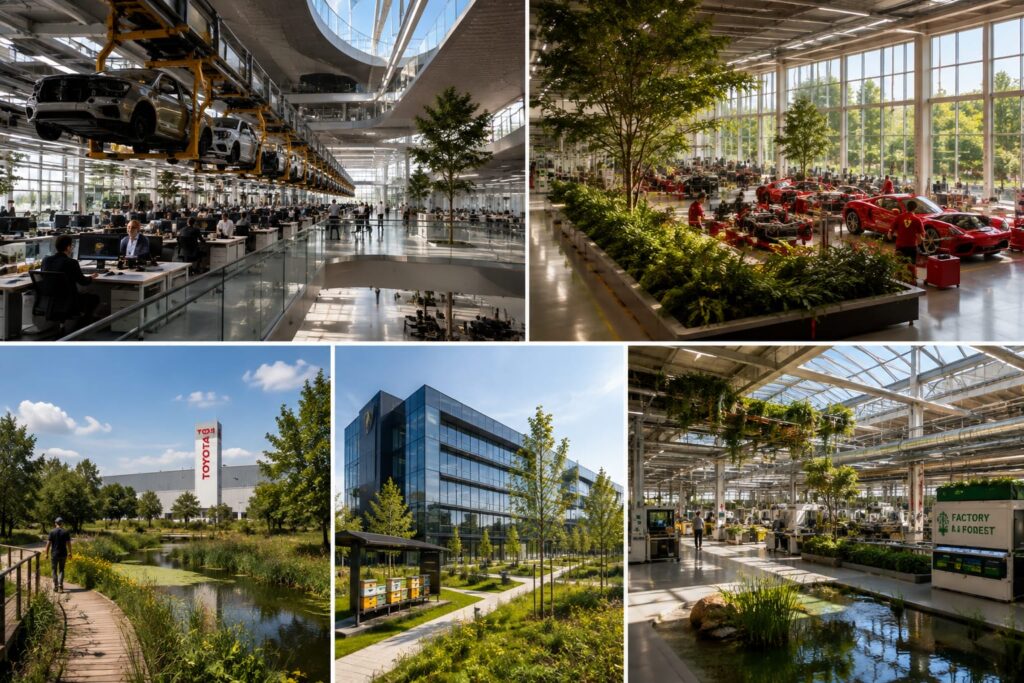
The intervention. In 2005, BMW inaugurated the central building of its Leipzig plant, designed by architect Zaha Hadid. The most radical design choice was to route the production line, cars still being assembled and suspended on an overhead conveyor, directly above the desks of the design and administrative offices, in a single space shared by roughly 750 people, both factory workers and office staff. Workers? locker rooms and social areas were also placed on the first floor, mixed in with administrative spaces, eliminating separate paths for different categories of employees.
The benefit. The building received the Deutscher Architekturpreis (German Architecture Prize) and, twenty years later, is still cited as a textbook case of how industrial architecture can concretely communicate the absence of status hierarchies between production workers and office staff, a message that translates into internal cohesion and a strong differentiator for BMW?s employer branding.
2. Ferrari, Maranello (Italy): Natural Light, Greenery, and Wellbeing as Design Priorities
The intervention. Since 1997, Ferrari has run ?Formula Uomo? (?Human Formula?), a multi-year program, with a total investment of over ?200 million, to improve working conditions across every area of the Maranello plant. Interventions include replacing old fluorescent lighting with large glass facades and natural light in the new assembly departments; adding green areas both indoors and outdoors between production departments; climate control and machinery soundproofing systems; plus a high-quality staff restaurant and fitness and preventive health programs for employees.
The benefit. In 2007, the Ferrari Maranello plant was named the best workplace in Europe, a recognition the company still cites today as a direct result of the Formula Uomo program. The case has become a reference in industrial architecture studies as an example of how the physical environment affects how people perceive their own work, even in a high-intensity manual production context.
3. Toyota, Burnaston (United Kingdom): A Nature Reserve Inside the Plant
The intervention. Toyota Motor Manufacturing UK, in partnership with the Derbyshire Wildlife Trust, transformed roughly 7.1 hectares of its industrial land at Burnaston, including catchment ponds created in 1990, into a natural area with wetlands, woodland, and biodiversity-rich meadows, accessible to employees during breaks. In 2005, the area was officially designated a Local Wildlife Site.
The benefit. According to the Derbyshire Wildlife Trust, having an easily accessible green space within the workplace produced a measurable improvement in employees? perceived wellbeing, alongside concrete ecosystem services such as stormwater regulation and improved water quality. A ten-year management plan, renewed over time, ensures the project?s continuity.
4. Lamborghini, Sant?Agata Bolognese (Italy): The Factory as Sustainable Infrastructure
The intervention. Lamborghini?s production site has built environmental sustainability into the architecture of the plant itself: the Torre 1963 office building, opened in 2017, achieved Italy?s record score (92 points) under LEED Platinum certification, the highest international standard for building energy and environmental efficiency. The site is also home to ?Lamborghini Park,? a green oasis opened in 2011, and an apiary that monitors air quality and produces honey distributed to employees each year. Even the factory expansion for Urus production, from 80,000 to 160,000 square meters, was designed to preserve the net-zero CO2 emissions certification the plant achieved in 2015.
The benefit. The new paint shop built for the Urus achieved a 30% reduction in land use compared to a comparable facility, while the entire site retained its carbon-neutral certification even after doubling its production footprint, demonstrating that industrial growth and spatial sustainability are not in conflict, but are designed together from the outset.
5. Interface, LaGrange and Atlanta (United States): The Factory Designed as an Ecosystem
The intervention. Interface, a US manufacturer of textile flooring, worked with Biomimicry 3.8 and the design firm Terrapin Bright Green to develop ?Factory as a Forest,? completed in 2017: a method for designing plants so they provide the same services as a high-performing forest ecosystem, stormwater management, air quality, carbon sequestration, instead of simply minimizing environmental impact.
The benefit. According to the design firm that developed the method, the result is a working environment explicitly described as ?regenerative? for employees. The project fits into a broader company journey that, since the mid-1990s, has cut landfill waste by 92%, greenhouse gas emissions by 96%, water use by 89%, and energy consumption by 46%, showing that rethinking production space as part of a natural system delivers environmental and human benefits together, not one at the expense of the other.
What These Five Cases Have in Common
None of these interventions were done as a trend. In every case, the change to the physical space responded to a precise objective: integration between roles, worker wellbeing, sustainability, employer branding, and was paired with concrete measurement of the result achieved, whether an architecture award, a best-workplace title, an environmental certification, or a biodiversity metric.
The message for anyone designing or renovating a production environment today is that space is not a neutral backdrop to the process it houses: it is itself a design lever, with a measurable return just like an investment in new machinery.
Main Sources Cited
- Zaha Hadid Architects / Zaha Hadid Foundation: BMW Central Building, Leipzig.
- Ferrari S.p.A.: ?Formula Uomo? program, industry case studies (Automotive Manufacturing Solutions, Luxurious Magazine).
- Derbyshire Wildlife Trust: Toyota Manufacturing UK Case Study, Burnaston.
- Automobili Lamborghini S.p.A.: Sustainability Report and Audi MediaCenter releases.
- Interface Inc.: Mission Zero and the ?Factory as a Forest? project (Terrapin Bright Green, Biomimicry 3.8).